Betsy’s College Experiment

Betsy enrolls at the University of Minnesota in 1910. Interestingly, it was not that uncommon for women to enroll in college at that time. Men and women of that era went to college in roughly equal numbers. Male enrollments reached a high point in the late 1940s, as GIs returned from World War II. Overall enrollment numbers continued to rise to the current day, and as increasing numbers of young women began to expect to participate in the workforce, female enrollments began to outpace male enrollments.

In her freshman year, Betsy suffers a serious attack of appendicitis, and spends much of that year in California, recuperating at her grandmother’s home. She does lots of writing and her stories begin to sell. “I found myself out there,” Betsy later decides (p. 15, Harper Trophy paperback edition, 1996). But she misses out on almost an entire year of college, and when she returns to the U the next year, she is still considered a freshman.

Officially a freshman, while Joe and her other friends are sophomores, the year goes by quickly. Betsy is writing for the school magazine and serving as Women’s Editor of the school newspaper. One of her stories seems especially good, and one of the college’s more famous and well known professors writes her a letter of encouragement. Betsy’s interest in math and science, never strong, suffers as her writing improves.

The next year, Joe receives a scholarship and transfers to Harvard, and Betsy loses interest in academics altogether. She also begins a relationship with fellow student Bob Barhydt, which begins as an innocent flirtation but becomes somewhat more exclusive, as several photos in the school yearbook document. Joe sees these pictures, and his letters to Betsy grow “cold as ice” (p. 17, Harper Trophy paperback edition, 1996). Joe spends no time with Betsy that summer. It seems his love is now ice cold as well.

Betsy’s father sees Betsy’s unhappiness and how little she is getting out of college. He and Betsy have a frank talk in which he expresses to her that while he generally advises that a person finish what they start, it is also good to know when to make a break from something that isn’t working, and go in a different direction. He is talking about education, not Joe, but for Betsy, his words may represent an opportunity to heal her heart.

There are many paths to education, Mr. Ray declares. He presents Betsy with a breathtaking offer: she could drop out of school and take a trip overseas similar to the one that Julia had taken. It would be a broadening experience for a writer, he says. Betsy, who has always wanted to travel (although with Tacy — who is now married and unavailable!), is gratified. She agrees to go, accompanied, initially, by professor friends of Mr. Ray’s brother, who are brother and sister. Betsy suggests that she spend significant periods of time in just a few cities, rather than traveling around constantly. It would be good experience, she thinks, for a writer to become deeply immersed in a few new cultures.

As the plan takes shape, Betsy’s time in college comes to an end, and her venture into the Great World begins.

On gendered college enrollment trends, see: https://eml.berkeley.edu/~saez/course131/gkk_jep.pdf
Crossing the Atlantic

Betsy leaves for Europe on the ocean liner S.S. Columbic, which will take her and her traveling companions, the Wilsons, to Genoa, where she will transfer to Munich. Immediately she becomes homesick and heartsick, for she catches a glimpse of Joe covering the ship’s departure for the newspaper, though they do not cross paths. She will be reminded of Joe constantly on her travels; it is obvious that she is still very much in love with him.

Betsy disguises her sadness as seasickness and spends a day or so in her cabin, in bed, miserable. But soon her instinct for companionship and adventure beckons, and she avails herself of ship events (dinners, dances, strolls on deck) and excursions (Madeira, the Azores, Algiers). Before long she has met Taylor and Rosa, actual ladies’ maids, like the ones she has written about; the ebullient Mr. O’Farrell, who looks like her favorite singer Chauncey Olcott; a great new friend from Toronto named Maida; and the famous author Mrs. Main-Whittaker.

The early 1900s represented a kind of golden age of translatlantic ocean travel. Ocean liners were spacious, loaded with amenities, and could accommodate over 1,000 travelers. Most trips overseas took a little less than a week. By the 1950s, ocean liners became rare due to the rise of air travel, and the now super-popular cruise ship industry was born.

Dinner conversations on the ocean liner range from art to music to a women’s right to vote. Mr. O’Farrell is shocked that sweet Betsy considers herself a suffragette. “We’re having a suffrage parade in Minneapolis this spring,” she says. “I’d be marching if I were there.”

“But you’re not a militant?” O’Farrell responds. Betsy isn’t sure that she would characterize herself such. But she knows that she would never back down when presented with such a challenge as voting rights. “I would be if I had to be,” she declares (p. 73, Harper Trophy paperback edition, 1996).

On the ocean liner as a primary means of transportation, see: https://transportgeography.org/contents/chapter1/emergence-of-mechanized-transportation-systems/liner-transatlantic-crossing-time/

For an interesting depiction of life on a translatlantic ocean liner in Betsy’s era, see: https://www.ggarchives.com/OceanTravel/TravelGuide/31-WhatToExpectOnYourVoyage.html

Proposal, Engagement, Wedding, Honeymoon

The S.S. Richmond sails into New York City’s inner harbor in September of 1917, signaling the end of Betsy’s travels abroad, and Joe is there to meet her. They reunite ecstatically, rushing into one another’s arms, and their future is immediately sealed, all past slights forgotten. They spend the day touring the city and buying a wedding ring at Tiffany’s, and Joe proposes in a small Greenwich Village restaurant. “Love me always, Betsy!” he cries. “I have given my whole heart to you” (p. 23, Harper Trophy paperback edition, 1996).

Joe quits his job in Boston and packs up his life to return to Minneapolis, for Betsy does not want to leave her family so soon after a year away. He returns within a week, expecting to find a job at one of the city newspapers, but without one immediately available, takes a position working for the Hawthorne Publicity Bureau. He asks Mr. Ray for Betsy’s hand in marriage, and it is decided that Betsy and Joe will marry the very next day, which will give them three days for a honeymoon before Joe starts his new job that Monday.

A small home wedding is hastily arranged, complete with a store-bought dress for Betsy, a cake homemade by Anna, and a bridal bouquet of pink roses and blue forget-me-nots. Small home weddings were common in 1917, usually held in the afternoon, followed by refreshments, as with this wedding. The dress was often simple and flowing, and the wedding ring was often a simple gold band, just like Betsy’s. In the modern era, weddings are likely to be customized to reflect the tastes and budget of the bride and groom and their families, with a wide range of ways to celebrate, including destination weddings, avant-garde gatherings, elopements, and commitment ceremonies that do not constitute an official wedding.

After so many years of loving him (p. 57, Harper Trophy paperback edition, 1996), Betsy and Joe are married in front of the Ray fireplace. Tacy and Harry Kerr, who have married and are expecting a baby, loan Betsy and Joe their cottage on Lake Minnetonka for a honeymoon, and Betsy and Joe spend a few idyllic days planning their life. It’s a simple but perfect beginning to what will be a rewarding but challenging first year of marriage.

For more on weddings in Betsy’s era, see: https://bungalowclub.org/newsletter/spring-2019/now-join-hands/

For more on modern weddings, see https://www.courtly.com/resources/wedding-ettiquette

Betsy and Joe’s Marriage

Betsy and Joe find an apartment and settle into it and into their marriage. Betsy makes a list of rules for married life for herself centered mostly around being a good wife, housekeeper, and cook, which she expects to be her greatest challenge, and one that she approaches with grit and determination. Maintaining house and home was the responsibility of women back then, and while women have more freedom today, to some extent the expectations underlying those norms remain. Total gender equality has certainly not been reached, nor has pay equity. But a true partnership is more possible today, as are same-sex marriages, in which household labor is not divided by gender.

Still, Betsy and Joe approach their marriage as a partnership, which, for that era, it was. He supports her writing and helps her make time for it. He is attentive to her needs and feelings. They treat one another with care and respect. While their sex life is only implied, it is obvious that they find one another highly attractive and sexy, and that Joe is especially fond of the pink silk lingerie that he periodically asks her to put on.

Their easy work-leisure routine is interrupted by the request of Joe’s Aunt Ruth to come live with them. They decide to buy a house so as to have the space to accommodate her. While Betsy is initially unhappy and worried that a new arrival (that isn’t a baby) would be disruptive to their lives, she comes to love Aunt Ruth and accept her presence in their home.

Joe takes a job working late night hours at the paper for more money, and finds himself struggling with the work and with his colleagues. He is increasingly moody and sometimes shuts himself off from Betsy. But they continue to support one another’s wellbeing, hopes, and dreams, and their love deepens.

On women’s rights and marriage, see: https://www.law.georgetown.edu/georgetown-law-journal/in-print/volume-108/nineteenth-amendment-edition/reconstructing-liberty-equality-and-marriage-the-missing-nineteenth-amendment-argument/#:~:text=The%20social%20movement%20that%20led,as%20to%20women%20as%20citizens.

The Digital Betsy-Tacy Project is an initiative born at Rutgers University in 2025. In it, we explore the experience of revisiting literature and media from one’s childhood as we take a journey through the Betsy-Tacy books, Maud Hart Lovelace’s classic, much-loved series of children’s/young adult historical fiction.

In the first phase of the project, depicted on this website, we gather, curate, research, and analyze some of the most important moments and themes in the books. We also consider how they may relate to, and even help us understand, life in a modern, digital society. Subsequent phases of the project will explore in greater depth themes and insights that are surfaced here and may extend the study to other classic children’s books and media.

The Digital Betsy-Tacy Project was publicly launched at the Betsy-Tacy Convention in Mankato, MN in October 2025. Posts continue to be added afterward, here on this site and in the Project’s LinkedIn Group, The Digital Betsy-Tacy Project. Just click on the book titles in the navigation menu to view the posts associated with each one, and feel free to join the LinkedIn group.

Wit, wisdom, insights, and lessons of all kinds abound in these “tomes,” as they are affectionately referred to by Lovelace’s legion of admirers. This project is not meant to be an exhaustive collection of these, but a repository upon which others may build. Ideally, the relevance and the significance of the Betsy-Tacy series to generations of readers of all ages (including my Rutgers students!) will be enhanced and preserved, and many more reimaginations will follow.

Content on the Digital Betsy-Tacy Project website may be accessed free of charge and freely shared for personal and/or educational purposes. Cite and credit the Digital Betsy-Tacy Project when sharing, repurposing, or teaching this material.

The Digital Betsy-Tacy Project is directed by Mary Chayko, Ph.D., its principal researcher, writer, and editor. Dr. Chayko is a sociologist, author, and professor at Rutgers University’s School of Communication and Information. She has been studying life in a digital society for over 30 years. She speaks nationally and internationally and publishes widely on the impact of digital technology on everyday life, relationships, community, and the self. Her books include Superconnected: The Internet, Digital Media, and Techo-Social Life (Sage Publications, 3 editions: 2021, 2018, 2016, plus translations in Korean, Turkish, and Serbian), Portable Communities: The Social Dynamics of Online Connectedness (SUNY Press, 2008), and Connecting: How We Form Social Bonds and Communities in the Internet Age (SUNY Press, 2002).

She can be reached at mary dot chayko at rutgers dot edu.

Welcome!

The Digital Betsy-Tacy Project is a journey through Maud Hart Lovelace’s classic, much-loved series of children’s/young adult historical fiction, the Betsy-Tacy books. We gather and analyze key moments in the books as we explore the experience of revisiting literature and media from one’s youth. Come along for the ride!

Based at Rutgers University, the project provides an overview of some of the most important and revelatory vignettes in the Betsy-Tacy books and considers how they relate to and even help us understand life in a digital society. Click on the book titles in the navigation menu to view the posts associated with each book. New posts are added weekly on this site and in the LinkedIn group The Digital Betsy-Tacy Project (feel free to join!), following the project’s public launch at the Betsy-Tacy Convention in Mankato, MN in October 2025.

Subsequent phases of the project will explore in greater depth some of the themes that surface in this stage and may extend the study to other classic children’s books and media. All in all, it promises to be a fun-filled journey providing a fresh examination and reimagination of these classic works and how they may impact our own life stories and worlds.

We begin with the first book in the series, Betsy-Tacy, set in 1896-97 and published in 1940, and continue through to Betsy’s Wedding, set in 1917-19 and published in 1955. Throughout the ten volumes, the story becomes progressively more complex in style and substance as the characters age from childhood to early adulthood. An intimate look at early 20th century life that is drawn from Lovelace’s own personal experiences, the books are historically accurate yet completely timeless, and surprisingly relevant to the present day.

In the familiarity and warmth of the literature of the past can arise great wisdom, wit, insights, and lessons that are highly relevant to life today. The Digital Betsy-Tacy Project gathers and preserves them here, free of charge, for pleasure, practicality, and educational purposes. Browse, read, share, teach, enjoy! HarperCollins paperback versions of these books can be found at the links below:

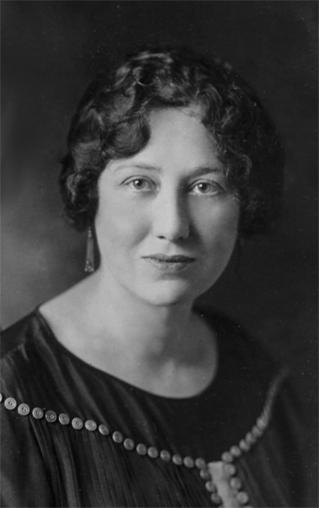
Maud Hart Lovelace

Maud Hart Lovelace (1892 – 1980) was the author of the Betsy-Tacy books, as well as other stories and books for children, young adults, and adults. Born and raised in Mankato, Minnesota, she was a writer all her life, asking her mother how to spell “going down the street” at the age of five.

The Betsy-Tacy series was based on Maud’s experiences growing up with her parents, sisters, and a crowd of friends, all of whom are represented in the books, with names and some personal characteristics altered. Maud was “Betsy” in the series; we see the story through her eyes. Maud’s best friend, Frances “Bick” Kenney, was Betsy’s bashful bestie Tacy in the books; their spirited pal Marjorie “Midge” Gerlach was their dear friend Tib.

Maud’s husband Delos Lovelace, also a noted author, was Joe Willard in the Betsy-Tacy high school books. Their story of falling in love was fictionalized to fit into Betsy’s timeline, as Maud did not meet Delos until a bit later in life. Maud and Delos Lovelace had one daughter, Merian, and an infant son who lived only hours. Maud liked to tell Merian stories about her life growing up in Mankato, and Merian and Delos were so charmed by the tales that they encouraged her to write them down.

Those stories became the Betsy-Tacy books. Maud’s hometown of Mankato became, famously, “Deep Valley.” The stories provide a fascinating glimpse into life in the late 1890s and early 1900s in a small midwestern town. Even more remarkably, they reveal that much about life, love, and friendship remains the same today as a century ago.

Memorably, ingeniously, Maud wrote with progressively more sophisticated language, tone, and narrative as the children age throughout the series. The first book, Betsy-Tacy, has the simplest structure, and is for grade school children. As Betsy and her friends grow older, their relationships deepen, along with the situations and challenges they face. The later books take Betsy and her friends through high school and into adulthood, and are written for a young adult / adult audience.

Many themes are carried through the series, however. These include: the centrality of friendship and family; the value of independent thought and action, especially for women; the pleasures of writing, music, and travel; the importance of planning, discipline, perseverance, adaptability, spirituality, loyalty, and staying true to oneself in a life well and fully lived.

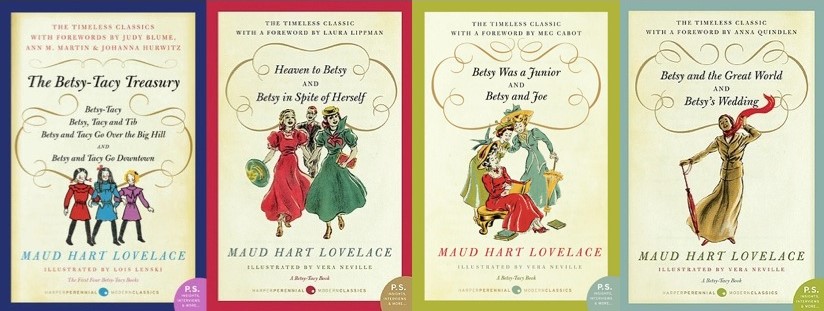
Maud’s legacy is enshrined in the Maud Hart Lovelace Book Award (by the Minnesota Youth Reading Book Awards), and in the devotion of generations of readers, many of whom gather virtually and occasionally physically via social media groupings, email lists, group chats and book discussions, and as the Betsy-Tacy Society. The Society has restored Betsy and Tacy’s original houses on Center Street in Mankato (Hill Street in Deep Valley, in the books) and is a resource for all things related to the books and to Maud Hart Lovelace. See https://www.betsy-tacysociety.org/ for more on the Betsy-Tacy Society. The books are published by Harper Collins and available at:

Maud Hart Lovelace also wrote three books in which Betsy and other Betsy-Tacy characters appear: Emily of Deep Valley, Carney’s House Party, and Winona’s Pony Cart. These are also delightful, and are important additions to the Betsy-Tacy canon, but as Betsy is not the lead character in these books, they are not highlighted in the Digital Betsy-Tacy Project at this time.

Photo of Maud Hart Lovelace: Estate of Merien Kirchner; HarperCollins website. Photos of books: Harper Collins website

Reading/Teaching/Discussion Guide — from the Betsy-Tacy Society

The Betsy-Tacy Society, a wonderful nonprofit organization dedicated to the preservation of the Betsy-Tacy books and houses, has developed the following guide for parents, teachers, and librarians interested in introducing the Betsy-Tacy books to children (and others!) Below are links to the guide and to the Betsy-Tacy Society website.